
Myth vs Fact Video: Finance and Education Examples
A myth vs fact video states a common belief, then corrects it with a fact and names the source on screen, in about 20–40 seconds. To make one without filming, write a short brief (the myth, the fact, the source, who it's for), approve the AI-written script, then approve the video. Below: a finance and an education example, and hooks to adapt.
Want a slide or graphic instead? A design tool fits better: in our autocomplete pull (Viralflicks, 2 Nov 2026, Google / YouTube / Bing, US + UK), 14 of the 18 suggestions for "myth vs fact template" asked for a template, slide, flyer, image or infographic, while YouTube suggested "myth or fact shorts" for "myth vs fact video".
What makes a good myth vs fact video?
A good myth vs fact video makes one myth, one fact and one named source fit in 4 beats:
| Beat | Time | On screen | Job |
|---|---|---|---|
| 1. Myth | 0–3 s | "MYTH: …" in big text | Stop the scroll with a belief the viewer holds |
| 2. Why people believe it | 3–10 s | One short line | Show you understand the viewer |
| 3. Fact + source | 10–25 s | "FACT: …" + source name | Correct it, name who says so |
| 4. Takeaway | last 3–5 s | One action or one line | Give them something to do or remember |
For finance and education, name the source on screen and add no numbers the source doesn't give.
How do I make a myth vs fact video from a brief?
In Viralflicks it takes 5 steps:
- Write the brief. Topic, style, target length, voice, language and format (9:16 for Shorts and TikTok).
- Approval 1: approve the script. Check the myth, the fact and the source line. Approve, regenerate or discard. Writing and changing your storyboard is free; credits are spent on the render.
- The video renders with voiceover, subtitles and background music, each of which can be switched on or off (voiceover or music must stay on). If a render fails, the credits are refunded automatically.
- Approval 2: approve the video, save it as a draft, or discard it.
- Publish. Publish or schedule to YouTube; TikTok gets a draft you post from the TikTok app.
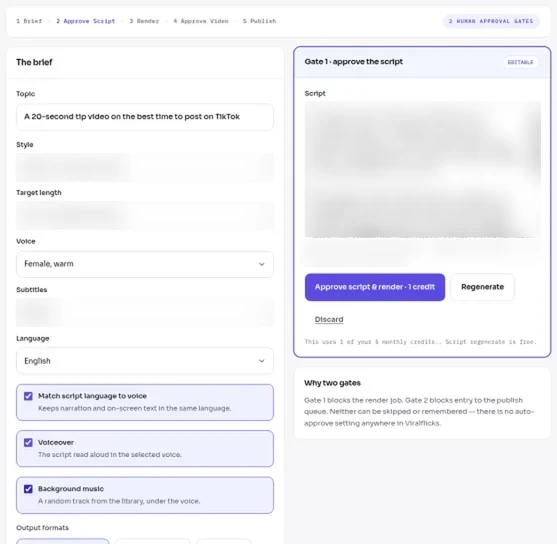
Approval 1: the brief form beside the AI-written script (test account, different example topic; script blurred).
More on the two approvals: Approve the script, then generate — human gates for AI video. How the TikTok draft works: TikTok Draft vs Direct Post — after Gate 2, you still own the click.
Finance example: what does the brief and script look like?
One myth about credit, one fact from the US Consumer Financial Protection Bureau (CFPB), and a "general information" line.
Brief (what you type in):
Topic + who it's for: Myth vs fact: checking your own credit report hurts your credit score. For US viewers who are starting out with credit.
The one point: checking your own credit report doesn't affect your score (source: CFPB).
Length + style: 25–30 seconds, myth vs fact, calm voiceover, subtitles on, 9:16.
Example script (written by our team to this brief to show the shape; the AI-written script you get will differ, and you edit or regenerate it before approval 1):
| Time | On screen | Voiceover |
|---|---|---|
| 0–3 s | MYTH: Checking your credit report hurts your score | "Myth: checking your own credit report hurts your credit score." |
| 3–10 s | Why people think so | "It sounds right. Lenders checking your credit can show up on your report." |
| 10–22 s | FACT: Checking your own report has no effect on your score · Source: CFPB | "Fact: the CFPB says checking your own credit report isn't an inquiry about new credit, so it has no effect on your score." |
| 22–28 s | Check yours for errors · General info, not financial advice | "Reviewing it can help you spot mistakes. General information, not financial advice." |
Source: CFPB: Does requesting my credit report hurt my credit score? (last reviewed 14 May 2024, checked 5 Nov 2026). This is a US source, so the brief names US viewers.
Education example: what does the brief and script look like?
One myth about studying, one fact from a 2013 review of study techniques, and a takeaway to try.
Brief (what you type in):
Topic + who it's for: Myth vs fact: rereading your notes is the most effective way to study. For students revising for exams.
The one point: a review of 10 study techniques rated practice testing and spreading study over time highest, and rereading low (Dunlosky et al., 2013).
Length + style: 25–30 seconds, myth vs fact, energetic voiceover, subtitles on, 9:16.
Example script (written by our team to this brief; the AI-written script will differ):
| Time | On screen | Voiceover |
|---|---|---|
| 0–3 s | MYTH: Rereading your notes is the way to study | "Myth: rereading your notes is the most effective way to study." |
| 3–10 s | Why it feels right | "It feels productive. The page looks familiar the third time." |
| 10–22 s | FACT: Practice testing + spaced study rated highest; rereading rated low · Source: Dunlosky et al., 2013 | "Fact: a 2013 review of 10 study techniques rated quizzing yourself and spreading study over time highest. Rereading was rated low." |
| 22–28 s | Try it: close the notes, quiz yourself | "Next time, close your notes and quiz yourself instead." |
Source: APS: Which study strategies make the grade?, on Dunlosky et al., Psychological Science in the Public Interest, 2013 (checked 5 Nov 2026).
Which hooks can I use for a myth vs fact video?
Use hooks that state the myth in the viewer's own words within the first 3 seconds:
- "Myth: [belief]. Here's what [source] says."
- "You've probably heard [belief]. It's a myth."
- "Stop [habit]. [Source] says it doesn't do what you think."
- "[Belief] sounds right. Here's the fact."
Fill each bracket from your brief, and keep the source name for beat 3.
How do I keep finance and education myth videos accurate?
Check each fact at approval 1, before anything renders:
- One fact, one named public source (a regulator, a government page or a published study), with the date you checked it in your notes.
- No numbers the source doesn't give.
- No personal advice: no "you should buy", "you should invest" or "this will raise your grade".
- Finance videos say "general information, not financial advice".
- The source's country matches your audience (for example, a US source for US viewers).
If a line fails, edit the brief and regenerate. To compare tools for this kind of short, read Honest AI video tools compare — pick the job, not the buzzword.
Write your first myth vs fact brief
Write a myth vs fact brief and approve your first script. Nothing renders until you approve it.
By Hanif Jadoon, Head of Growth & SEO · Updated 11 Nov 2026
Frequently asked questions
A myth vs fact video is a short video that states a common belief, then corrects it with a fact and names the source on screen. It usually runs 20–40 seconds and ends with one takeaway.
Yes. In Viralflicks you write a brief, approve the AI-written script, and the video renders with an AI voiceover, subtitles and background music, each of which can be switched on or off (voiceover or music must stay on).
It shouldn't be. Keep it to general facts from a named public source, say on screen that it's general information, and leave out any "you should buy" or "you should invest" lines.
Yes. Choose the 9:16 format. Viralflicks lets you publish or schedule to YouTube; TikTok gets a draft you post from the TikTok app.
See it in Viralflicks
Connect a channel, open Analytics, and ask the AI Advisor what to do next.